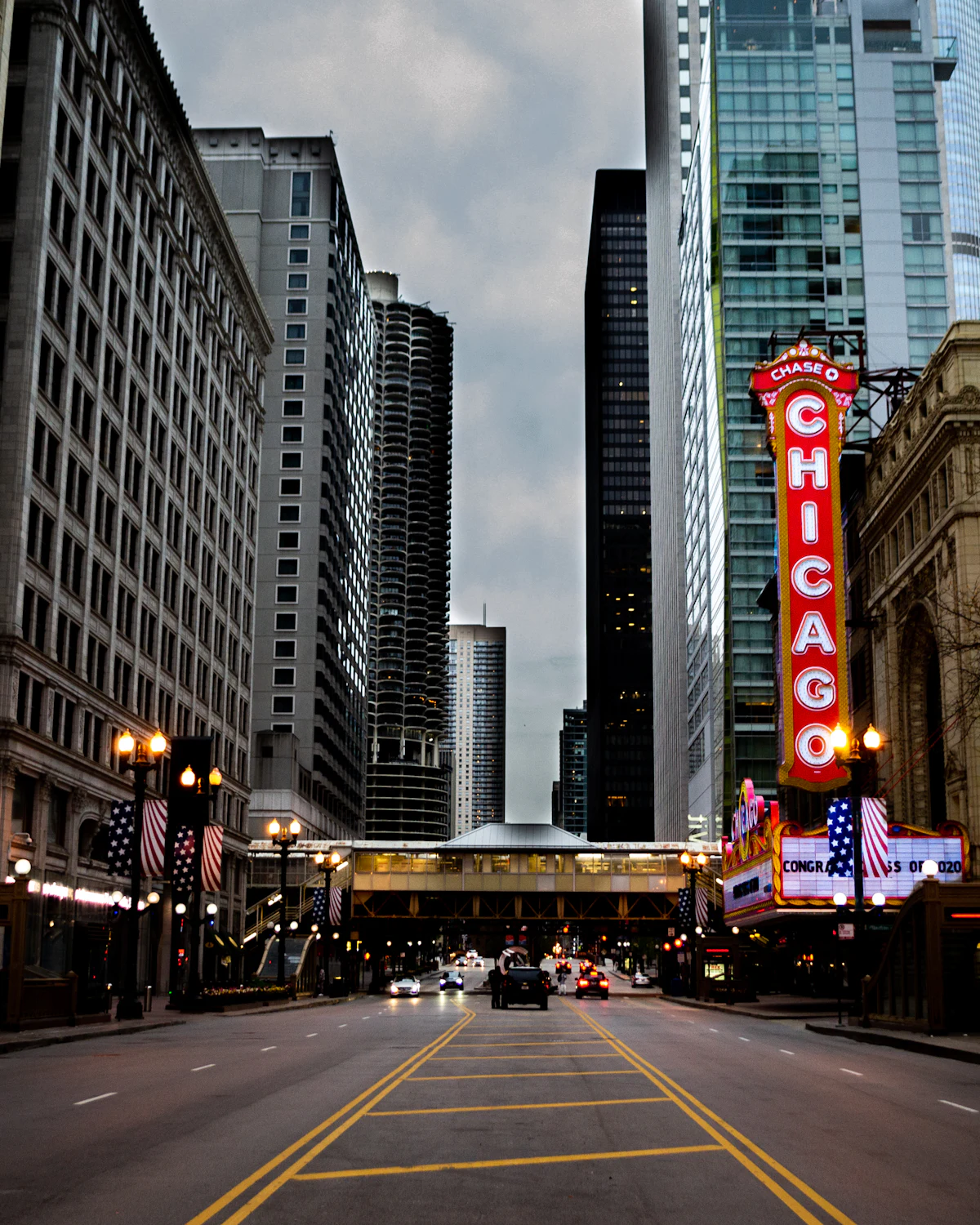
Chicago sign permit at a glance
| Question | Short answer |
|---|---|
| How big can my signs be in total? | Set by zoning district and street frontage: a B1 lot gets 3 × street frontage or 600, whichever is less, and a C2 lot 5 × street frontage or 1,800, whichever is less (§17-12-1003-E) (district table). Other cities compared. |
| Freestanding sign? | 50% of the maximum total sign area limit. Other cities compared. |
| When does City Council get involved? | A sign over 100 sq ft, or higher than 24 ft above grade, requires a City Council order in addition to the standard permit (why signs get rejected). |
| Which signs need no permit? | Among others, an adhesive or static cling window sign and a temporary paper, fabric or vinyl window sign for no more than 60 days, as long as all signage in a single window does not exceed 25% of the glazing area (permits and fees). Other cities compared. |
| What does it cost? | The zoning review fee is $200 for Business Identification signs; the building review fee is set by area, from $50.00 for 0-49 square feet to $1,000.00 for 500 square feet or larger. |
| How long does it take? | The Department of Buildings publishes no review or processing time for sign permits, so this page gives none. Other cities compared. |
| How do I file? | Online in the Department of Buildings E-permit section; an application without a site plan is returned (procedure). |
| Who can install it? | A business owner can install a sign themselves, unless the sign needs stamped drawings under 14E-6-600.28; then a licensed general contractor must be listed on the application. Electrical work needs a registered electrical contractor. Other cities compared. |
| Window signs? | A temporary window sign of paper, fabric or vinyl needs no permit for no more than 60 days, if it covers 25% or less of the window. Other cities compared. |
| Sidewalk A-frame sign? | A separate BACP permit at $100 per year, for storefronts outside the Central Business District; one per street address, no larger than six square feet per face and no taller than four feet (sidewalk signs). Other cities compared. |
| Grand opening banner? | Only a paper, fabric or vinyl sign in a window, for no more than 60 days, is exempt from a permit. (details) Other cities compared. |
| Already installed without a permit? | After a stop work order, work can resume only once you get the permit and pay the stop work order penalty ($1,000+); in most cases the building permit fee is then tripled (Department of Buildings). Other cities compared. |
| When does the permit run out? | The city’s supplemental sign permit application says the permit is valid for a period of five years after issuance and that the owner or lessee must file for renewal; once the zoning fee is paid, the application itself is valid for up to six months (application form). Other cities compared. |
Why signs fail By district How to apply FAQ District table Permit & fees Full procedure Timeline Sidewalk signs Sign companies
Why Chicago signs get rejected
Chicago regulates on-premise signs by zoning district under Chapter 17-12 of the Zoning Ordinance. The other trap is size and position: any sign over 100 sq ft or more than 24 ft above ground level needs a City Council order, and any sign or sign apparatus that extends over the sidewalk, parkway, street or alley needs a Public Way Use Permit and a City Council ordinance on top of the sign permit (Department of Buildings, Sign Permits).
This tool reads the same zoning rules the Department of Buildings enforces and tells you where your plan stands before you pay for fabrication or file a permit.
Chicago sign rules by district
Maximum total sign area by district, from the §17-12-1003-E table. Multiply your street frontage in feet by the factor; your total is that figure or the cap, whichever is less.
| District | Maximum total sign area (square feet) |
|---|---|
| B1 / B2 | 3 × street frontage or 600, whichever is less |
| DC / DX | 5 × street frontage or 800, whichever is less |
| B3 / C1 / C3 / DS | 4 × street frontage or 1,500, whichever is less |
| C2 / M | 5 × street frontage or 1,800, whichever is less |
Source: Chicago Zoning Ordinance §17-12-1003-E. Freestanding signs may use up to 50% of the total; wall signs are capped at 33% of the wall area; ground-floor tenants are guaranteed at least 32 sq ft. Whether a flashing or animated sign is allowed is set elsewhere in Chapter 17-12, in a part this page could not read, so the page makes no claim about it. Zoning Ordinance §17-12-1003-E (2026 S-74) · read 2026-10-02
How to apply for a Chicago sign permit — 5 steps
Chicago splits into a zoning review and the permit itself, and two thresholds can add a whole extra approval on top.
Steps assembled from the confirmed items on this page. The city’s own filing route is set out in “The Chicago sign permit procedure”, and its fee schedules and permit exemptions in “Do you need a permit, and what does it cost?”, both below. The city publishes no processing time.
What other cities ask you to submit: sign permit application checklists by city.
Questions owners ask — 6 questions
What each district actually allows: the §17-12-1003-E table
These standards apply to all permanent signs in B, C, M, DC, DX and DS districts. The rows are reproduced as the ordinance table states them — the area and height units sit in the row labels, and “whichever is less” means your total is the smaller of the per-foot figure and the cap.
| Standard | B1, B2 | DC, DX | B3, C1, C3, DS | C2, M |
|---|---|---|---|---|
| Maximum total sign area (square feet) | 3 × street frontage or 600, whichever is less | 5 × street frontage or 800, whichever is less | 4 × street frontage or 1,500, whichever is less | 5 × street frontage or 1,800, whichever is less |
| Max. freestanding sign area | 50% of the maximum total sign area limit above | |||
| Maximum freestanding sign height (feet) | 24; or 35 if located on a zoning lot with more than 75 feet of street frontage on a single street that has a right-of-way width of more than 80 feet; or 50 feet if located on a zoning lot with more than 150 feet of frontage on a single street with a right-of-way width or more than 80 feet | |||
| Minimum guaranteed wall sign area for ground-floor tenants | 32 sq ft | |||
| Maximum wall sign area | 33% of the building wall area | |||
The ordinance works its own example: a lot with 50 feet of street frontage in the B1 district is allowed a total of 150 square feet of total sign area, with no more than 75 square feet of freestanding signs.
For lots greater than 1 acre in area with multiple street frontages, the maximum total sign area standards apply per street frontage.
Source: Zoning Ordinance §17-12-1003-E (2026 S-74) · read 2026-10-02
Do you need a permit, and what does it cost?
When a permit is always required
A sign permit is always required for an off-premise sign.
Detail
The requirement is stated without exception, so none of the exemptions below reach an off-premise sign.
These are two separate charges named on two separate city pages — one a zoning review fee by sign type, the other a building review fee by sign area. Neither page states that both are charged on every application, so this section does not add them into a single figure.
Source: City of Chicago — Department of Buildings, Sign Permits, read 2026-10-02.
Signs that do not require a permit
- A temporary on-premise sign constructed wholly from paper, fabric, vinyl, or similar materials and attached to a window for no more than 60 days, provided that the total area of all signage in a single window does not exceed 25% of the glazing area — the percentage is measured against the glazing area, not against the wall or the sign.
- An adhesive or static cling sign attached to a window, on the same condition that the total area of all signage in a single window does not exceed 25% of the glazing area.
- Lettering painted directly on glass less than 2 inches in height.
- Incidental signs containing no commercial names or logos.
- Official signs, public notices and warning signs required by law or regulation.
Source: City of Chicago — Department of Buildings, Sign Permits, read 2026-10-02.
The two review fees
The zoning review fee is $200 for Business Identification signs and $500 for Advertising signs.
Source: City of Chicago — Signs: Business Identification (On-Premise) and Advertising (Off-Premise), read 2026-10-02.
The building review fee is set by the area of the sign: 0-49 square feet: $50.00; 50-99 square feet: $100.00; 100-199 square feet: $200.00; 200-499 square feet: $500.00; 500 square feet or larger: $1,000.00.
Source: City of Chicago — Department of Buildings, Sign Permits, read 2026-10-02.
The Chicago sign permit procedure, as the city’s own permit pages state it
How the application is filed
Sign applications are created and processed on-line in the Department of Buildings E-permit section. An application that does not include a site plan is considered incomplete and returned. The fee is paid by credit card at the application stage of the permit process.
Source: City of Chicago — Signs: Business Identification (On-Premise) and Advertising (Off-Premise), read 2026-10-02.
Who has to draw it and who has to install it
Sign types enumerated in 14E-6-600.28 require engineered, stamped architectural or structural drawings. Where those drawings are required, a licensed general contractor is required. Electrical work requires a registered electrical contractor.
Source: City of Chicago — Department of Buildings, Sign Permits, read 2026-10-02.
The processing time is not published in the city’s own guidance, so this page does not state one.
Timeline & temporary banners
Source: City of Chicago Department of Buildings (Sign Permits). Fees change — confirm current figures with the Department of Buildings before filing.
Detail
Permit fees are set out in “The two review fees” above.
The city page states no review or processing time, so this page gives none.
Sources & how this page is maintained
Sources and official references: City of Chicago — Sign Permits (Department of Buildings). Chicago Zoning Ordinance §17-12-1003-E (2026 S-74), American Legal Publishing. Measured on 21 August 2026: this city page carries the permit-fee amounts and the area thresholds quoted here. The 33% wall-coverage cap and the 32 sq ft ground-floor tenant minimum were read from the Chicago Zoning Ordinance §17-12-1003-E on 21 September 2026. The window-sign percentage this page used to quote has been removed: no readable copy of the current ordinance carried it. Re-read on 2 October 2026 against two city pages — the Department of Buildings sign permit page and the Department of Planning and Development page on business identification and advertising signs. What those two pages state is set out above in “Do you need a permit, and what does it cost?”: the off-premise permit rule, five exemptions, the $200 / $500 zoning review fees and the five-band building review fee schedule; and in “The Chicago sign permit procedure”: the on-line E-permit filing route with the site-plan requirement and credit-card payment, and the drawing and contractor requirements for the sign types enumerated in 14E-6-600.28. Both readings are stored verbatim in monitors/srccache. The four sections written from the 29 September 2026 reading were replaced by those two sections rather than kept beside them, so the same figures are not stated twice on this page. That page states no review or processing time, so this page gives none. Removed on 29 September 2026: the duplicate “What does a Chicago sign permit cost?” FAQ, together with its “paid by credit card up front before zoning review” wording and its citations to Municipal Code 17-13-0103-A and 13-32-310(E) — none of the three appear on the Department of Buildings sign permit page registered as this page’s source. The fee amounts themselves are on that page and are kept, in the fee section above and in the “How much is a Chicago sign permit fee?” FAQ.
Sidewalk (A-frame) signs
A sidewalk sign, such as an A-frame or T-frame set out on the public way, does not go through the Department of Buildings sign permit. It takes a separate permit from the Department of Business Affairs and Consumer Protection (BACP), open to storefront businesses outside the Central Business District with a valid Chicago business license. The permit runs five years from the date of issuance and costs $100 per year. The application needs a plan or sketch of the sign with its dimensions and wording, and proof of commercial general liability insurance.
What the sign itself must meet under Municipal Code 10-28-395:
- One sign per street address, placed on the sidewalk in front of the licensed business.
- No larger than six square feet per face and no taller than four feet.
- Not directly illuminated, static copy only, and no balloons, flags, lights or other attachments.
- Out only while the business is open to the public, and not in high wind or heavy rain or snow.
- An uninterrupted six-foot clear pedestrian path left, and at least a two-foot setback from the face of the curb.
- Not within 30 feet of an intersection, 20 feet of a crosswalk ramp or 12 feet of a driveway or alley, and at least 6 feet from any bicycle rack.
- Stands on its own: not chained or tied to anything, and not weighted down with sandbags, bricks or similar.
- The City decal issued with the permit displayed on it at all times.
Sources: BACP Sidewalk Signs page and Sidewalk Sign regulations, 10-28-395, read 10 October 2026.
Chicago sign companies that say they handle the permit
We are not affiliated with any of them and we are not paid to list them. Confirm licensing and pricing yourself before you hire.
| Company | Phone | Location | What their site says about permits | In-house |
|---|---|---|---|---|
| TFA Signs | 773-267-6007 | 5500 N Kedzie Ave, Chicago IL 60625 | Files the permit applications with the Chicago Department of Buildings | Family-owned since 1995, in-house fabrication, City of Chicago Class E general contractor TGC101080 |
| SignFreaks | (872) 250-4743 | 320 W Ohio St Suite 3W, Chicago IL 60654 | Manages the paperwork for permitting, zoning approvals and compliance | 25+ years, design, fabrication and installation, licensed and bonded |
| Chicago Signs and Screen Printing | 312-273-1833 | 3921 W Dickens Ave, Chicago IL 60647 | Installation and permit procurement available | Not stated on their site |
Detail
Compiled from each company's own public website.
Each company's website is linked from its name. Source pages read 6 October 2026.
Ask us how the code reads for your sign
Send your dimensions and we will reply with what the Chicago code allows for that sign. No charge. We are not a sign contractor and not a permit agent.