Nashville sign permit at a glance
| Question | Short answer |
|---|---|
| Do I need a permit? | Yes for most signs. Exempt signs under Title 17.32 need no zoning or building permit, unless they are regulated by size, height, setback, number or duration of placement (Codes sign permit page). Other cities compared. |
| Which permits? | A zoning permit and a building permit, and every permanent on-premises sign must be approved under an overall signage plan (how to apply). |
| How big can building signs be? | 15% of the facade they sit on, capped at 192 or 288 sq ft outside the §17.32.130 districts; building signs may not extend above the roof line (sizing). Other cities compared. |
| Ground signs? | From your district group's lot-frontage table: from 32 sq ft and 20 ft on a lot under 50 ft wide in the §17.32.110 districts up to 480 sq ft and 40 ft in the §17.32.130 districts. Other cities compared. |
| Roof signs? | Banned (prohibited signs). |
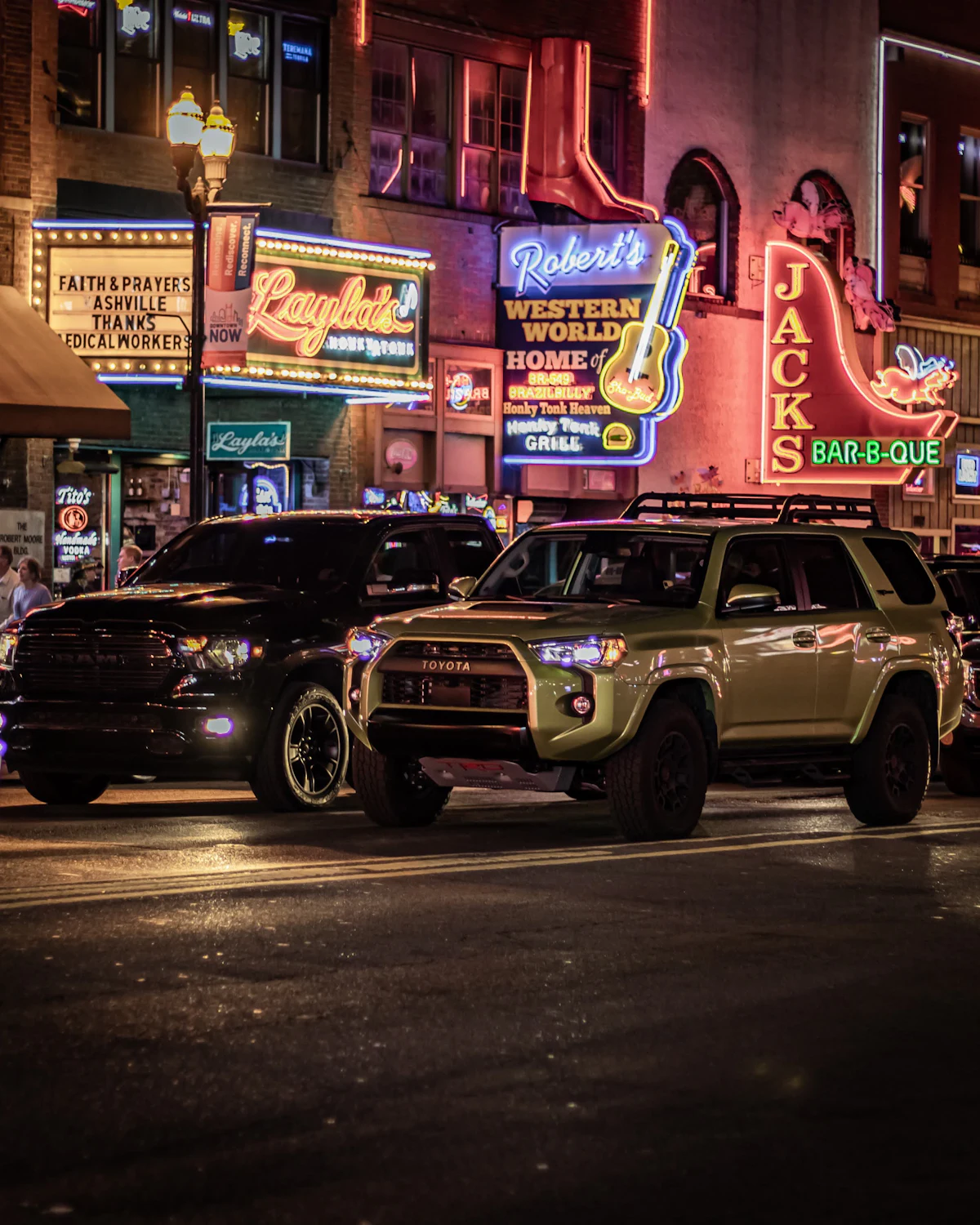
| Lower Broadway? | Inside a historic overlay the overlay can govern signs too (Broadway overlay). Other cities compared. |
| What does it cost? | By the valuation of the work, with a $55.00 minimum for a sign permit; electric signs carry a $20.00 electrical fee each (fee table). |
| How long does it take? | Metro publishes no review or processing time for sign permits. Other cities compared. |
| Grand opening banner? | A business that is opening may display one for no more than 60 days or until its permanent signs are installed. (details) Other cities compared. |
| Digital or LED sign? | Allowed only if each message stays fixed for eight seconds and changes instantly without special effects (§17.32.050(G)(1)); LED message boards and digital displays are prohibited outright in the districts listed in §17.32.050(H)(2), including CL and SCC (prohibited signs). Other cities compared. |
| Who files? | The owner of the property where the sign will be displayed, or the owner’s legal representative; once the sign is built, the person who built it certifies to the Department of Codes Administration that it was legally constructed (Metro Codes). Other cities compared. |
| When does the permit run out? | A permit under the building permit chapter, which covers signs, becomes invalid if work has not started within six months of issue or stops for one-hundred eighty days, and no permit is valid more than two years (§16.28.240). Other cities compared. |
| Only swapping the sign face? | Zoning and building permits are not required for painting, repainting or cleaning the sign structure, or for changing the copy on a sign designed for changeable copy (Codes sign permit page). Other cities compared. |
| Window signs? | Temporary, non-illuminated signs behind storefront windows, not permanently affixed to the glass, are exempt if they cover no more than twenty-five percent of the storefront window (§17.32.040 L). Other cities compared. |
Sizing How to apply FAQ Cost & timeline Exempt signs Prohibited signs Fees Sign companies
How Nashville sizes your sign
Chapter 17.32 groups the nonresidential districts into three tables. In every group, building (wall) signs are 15% of the facade they sit on. In the §17.32.110 districts (MUN, MUL, the O districts, CN, CL-A, CS-A, SCN) that is capped at 192 sq ft and two signs; in the §17.32.120 districts (ORI, MUG, MUI) at 288 sq ft for a single occupant. In the §17.32.130 commercial and industrial districts there is no cap, and permitted ground-sign area may be transferred onto the building with a 20% bonus on the amount transferred.
Ground signs come from a lot-frontage table for each group: from 32 sq ft and 20 ft on a lot under 50 ft wide in the §17.32.110 districts up to 480 sq ft and 40 ft in the §17.32.130 districts. The 900 sq ft figure in the CA district applies only to signs oriented to a controlled access highway (Table 17.32.130D, Note 3). Without scaled elevations, the facade is taken as 12 ft for the first floor and 10 ft for each floor above (§17.32.160). Metro Codes’ sign permit page states that roof signs are prohibited.
Source: Metro Code §§17.32.070, 17.32.110–17.32.130 and 17.32.160, read 10 October 2026 on Municode; Metro Codes, Sign Permit Process page, read the same day.
How to apply for a Nashville sign permit — 5 steps
Nashville needs a zoning permit and a building permit for a sign, and every permanent on-premises sign must be approved under an overall signage plan.
Source: Metro Codes, Sign Permit Process (last updated March 27, 2023), read 10 October 2026; Metro Code Chapter 17.32.
What other cities ask you to submit: sign permit application checklists by city.
Questions owners ask — 5 questions
Cost, timeline & temporary banners
Detail
Source: Metro Government of Nashville & Davidson County Code Ch. 17.32 (§17.32.060); Nashville.gov Codes Department (Sign Permit Process), read 10 October 2026.
Signs Nashville exempts from these rules — 18 items
§17.32.040 exempts a list of on-premises signs “from the operation of these sign regulations” — but the exemption is conditional, and the condition comes first: it applies only where the signs are not placed or constructed in violation of §17.20.180 (Visibility) “or so as to create a hazard of any kind through the obstruction of vision by motorists and pedestrians.” A sign on this list that blocks sightlines is not exempt.
The ones a storefront actually uses
- On-site direction signs — six square feet. Within nonresidential districts, signs displayed for the safe direction of the public on the property, such as signs identifying entrances, exits, drive-thru windows or similar. They “shall not exceed six square feet in area,” must not constitute a sign prohibited by §17.20.180, and must adhere to the height and setback provisions for permanent on-premises ground signs. §17.32.040(A)
- Flags in commercial and industrial districts — eight square feet, poles twenty-five feet apart. Flags of eight square feet or less mounted on individual poles, with the poles “separated by a minimum distance of twenty-five feet, except that four poles may be clustered at one location per street frontage.” Take the clustering option and “no other poles shall be erected along that street frontage.” The flags may contain a logo and are subject to the height and front setback requirements for the district. §17.32.040(I)
- Flags elsewhere. In districts other than commercial and industrial districts, non-commercial flags of eight square feet or less mounted on permanent poles attached to the ground or building. §17.32.040(H)
- Election-period temporary signs — twelve square feet, 120 days, seven days. Temporary signs not exceeding twelve square feet in area, up to 120 days prior to an election, removed within seven days after the election. §17.32.040(J)
- Event flags and bunting — 30 days, seven days. Flags and bunting up to thirty days prior to, and removed within seven days following, the celebration, convention or commemoration type event. §17.32.040(K)
- Behind the storefront window — twenty-five percent. Temporary displays and signs behind storefront windows that are not affixed permanently to the glass, are not intended for permanent display, and are non-illuminated, provided they “do not cover more than twenty-five percent of the total surface area of the storefront window.” All three conditions travel together. §17.32.040(L)
- Drive-through signs — sixty square feet, ten feet. A ground or building sign oriented toward a drive-through lane, up to sixty square feet in total and ten feet high, within thirty feet of the point where orders are taken. §17.32.040(W)
- One inflatable figure — twenty feet. In commercial districts, one inflatable moving figure per parcel, on a fixed base, at most twenty feet high, at least one thousand feet from a residential structure, daylight hours only; not on Lebanon Road, McGavock Pike, Elm Hill Pike or Donelson Pike frontage. §17.32.040(AA)
The rest of the list
- Signs necessary to promote health, safety and welfare, and other regulatory, statutory, traffic control or directional signs erected on public property with permission from the state, the United States or the Metropolitan Government. §17.32.040(B)
- Legal notices and official instruments. §17.32.040(C)
- Holiday lights and decorations. §17.32.040(D)
- Public warning signs indicating the dangers of trespassing, swimming, animals or similar hazards, for nonresidential uses. §17.32.040(E)
- Works of art that do not constitute advertising. §17.32.040(F)
- Signs carried by a person when the person receives no financial compensation. §17.32.040(G)
- Memorial signs or tablets cut into masonry, or made of bronze or other incombustible materials and attached to a building surface. §17.32.040(M)
- Signs incorporated into machinery or equipment by a manufacturer or distributor — the code names vending machines, newspaper racks, telephone booths, fee collection boxes and gasoline pumps. §17.32.040(N)
- In residential districts, a non-commercial sign not exceeding one square foot in area: one sign on the front of the house itself per lot, and a mailbox sign (one per dwelling unit). §17.32.040(O)
- Signs identifying safety or traffic-control measures on private property, such as “stop” and “yield” signs, meeting the Manual for Uniform Traffic Control Devices and not exceeding six square feet each. §17.32.040(P)
- Items (Q) to (V), (X) to (Z) and (BB) cover yard-sale, construction, for-sale, nonprofit-event and auction signs, interior and athletic-field signs, and farm-produce signs, each with its own size and day limits.
Source: Metropolitan Code of Laws, Title 17 Zoning, §17.32.040 Exempt signs, read 10 October 2026 on Municode. Areas, day counts, the pole spacing and the window percentage are reproduced as the code states them; the code writes several of them as words. §17.20.180 (Visibility), read 10 October 2026 in Chapter 17.20, bars anything at a street intersection that obstructs vision above the center line grades inside the triangle formed by the right-of-way lines and a line joining them at points thirty-five feet from their intersection (the urban zoning overlay and the DTC, CF, CF-NS, MUI and MUI-NS districts are exempt), and in all zoning districts bars any structure on private property that obstructs a driver’s view where a driveway meets a public street.
Signs Nashville prohibits — 6 items
§17.32.050 starts wider than its own list: “It is unlawful to erect, cause to be erected, maintain or cause to be maintained, any sign not expressly authorized by, or exempted from, this title.” Permission is the exception, not the default, and maintaining an existing sign counts.
The removal clause is the part worth knowing before you build. Any prohibited sign “may be removed by the zoning administrator or his designee after notice to the property owner or occupant to remove such sign(s) within three days.” Three days from the notice, and the removal can be done for you.
- Signs in violation of any other code adopted by the metropolitan government as stipulated in §17.32.020. §17.32.050(A)
- Signs or sign structures that interfere in any way with free use of any fire escape, emergency exit or standpipe, or that obstruct a window enough to reduce light or ventilation below what this title or another Metropolitan Code ordinance requires. §17.32.050(B)
- Signs that resemble an official sign or marker erected by a governmental agency, or that by position, shape or colour would conflict with the proper functioning of a traffic sign or signal, or that by size, location, movement, content, colour or illumination may reasonably be confused with, construed as, or conceal a traffic-control device. §17.32.050(C)
- Signs containing lighting or a control mechanism that causes unreasonable interference with radio, television or other communication signals. §17.32.050(D)
- Signs placed upon benches, bus shelters or waste receptacles, except as may be authorized under Metropolitan Code §12.48.090. §17.32.050(E)
- Signs erected on public property, or on private property such as private utility poles located on public property — other than signs erected by public authority for public purposes or as otherwise authorized by the metropolitan council. §17.32.050(F)
Changeable-message and digital signs — §17.32.050(G)
This is a condition, not a flat ban. Under (G)(1), a sign with any copy, graphics or digital display that changes messages by electronic or mechanical means is prohibited “where the copy, graphics, or digital display does not remain fixed, static, motionless, and non-flashing for a period of eight seconds with all copy changes occurring instantaneously without any special effects.” Eight seconds of hold, and an instant cut — no transitions.
Under (G)(2), such signs, other than tri-face billboards, “shall not be permitted in the CA, CA-NS, CS, CS-NS, CF, CF-NS SCR, SCR-NS, IWD, IR and IG districts unless the following distance requirements are satisfied, based upon the overall height of the sign”: a sign four feet or less in height shall not be less than one hundred feet from any agriculturally or residentially-zoned property (a), and each additional foot in height, or portion thereof, above four feet shall be set back an additional twenty-five feet from such property (b). The district list is reproduced as the code prints it.
The same subsection goes on. (G)(2)(b) gives its own example: a sign between five and six feet tall must sit at least one hundred fifty feet from agriculturally or residentially-zoned property. (G)(3) bans displays with varying illumination or intensity and every kind of motion effect — blinking, dissolving, fading, flashing, rotating, scrolling, twinkling or the illusion of movement. (G)(4) bans digital billboards, including converted ones, less than 2,000 feet apart, measured along the roadway. (G)(5) adds any digital billboard that does not meet §17.32.150. (G)(6) bars changeable-message signs in the CS district for automobile repair, used automobile sales, car washes and limited vehicular sales and services.
The rest of the list — §17.32.050(H) to (S)
- Video, continuous scrolling messages and animation signs, except in the CA and CA-NS commercial attraction districts. §17.32.050(H)(1)
- LED message boards and digital display signs in the agricultural, residential, MUN, MUL, MUG, MUI, MHP, office (ON, OL, OG, OR20, OR40, ORI), CN, CL, CS-A, SCC and SCN districts and their -NS and -A variants, with a narrow exception for signs existing as of January 1, 2014 in MUI-A along an arterial street in the urban zoning overlay. §17.32.050(H)(2)
- Signs with projected images, sound meant to attract attention, or live animals. §17.32.050(I)
- Signs that emit audible sound, odor, or visible matter such as smoke or steam. §17.32.050(J)
- Signs within ten feet of the right-of-way or 100 feet of traffic-control lights that contain red or green lights that might be confused with them. §17.32.050(K)
- Signs bright enough to cause glare or impair the vision of a motorist, cyclist or pedestrian. §17.32.050(L)
- Blank on-premises temporary signs. §17.32.050(M)
- Strings of incandescent bulbs over ten watts per bulb on commercial parcels, other than temporary holiday decorations. §17.32.050(N)
- Wind signs: non-exempt flags, pennants, ribbons, spinners, streamers, captive balloons under ten feet, or anything fastened to move in the wind. §17.32.050(O)
- Signs painted, pasted or printed on curbs, pavement, sidewalks or streets, except house numbers and traffic-control signs. §17.32.050(P)
- Vehicle signs: in residential districts, vehicles or equipment marked to advertise; in nonresidential districts, logo vehicles regularly parked on site must stay behind the front line of the building, and parking them to advertise is prohibited. §17.32.050(Q)
- Signs displaying copy harmful to minors. §17.32.050(R)
- Portable signs. §17.32.050(S)
That is the full list, (A) through (S), as amended by Ord. BL2019-111 (2020).
Source: Metropolitan Code of Laws, Title 17 Zoning, §17.32.050 Prohibited signs, read 10 October 2026 on Municode. The three-day notice, the eight-second hold, the district list and both distance figures are reproduced as the code states them. §17.32.020, §12.48.090 and §17.32.150 are cited but not described.
Signs in the Broadway Historic Preservation Zoning Overlay
Lower Broadway has its own sign rules. The Metro Historic Zoning Commission (MHZC) design guidelines for the Broadway Historic Preservation Zoning Overlay apply to all properties in the overlay, and sign permit applications there are made with and reviewed by the MHZC. Applications that do not involve a Modification need only MHZC administrative approval. The guidelines follow the “Pedestrian Street” type of the Downtown Codes Sign Standards adopted 1/30/2013.
| Sign type | Maximum area in the guidelines |
|---|---|
| Building signs (wall, awning, canopy, projecting) | 1.5 square foot per 1 linear foot of building façade or 36 square feet, whichever is greater; with a projecting sign, an additional 0.50 square feet per linear foot, for a total 2 square feet per linear foot |
| Shingle sign | 9 square feet per sign |
| Monument sign | 24 square feet |
| Skyline sign, building 75’ to 100’ | 480 square feet |
| Skyline sign, 101’ to 200’ | 600 square feet |
| Skyline sign, 201’ and taller | 720 square feet |
Linear feet are measured at grade. There is no limit on the number of building signs, except neon signs; the limit is the total square footage, the maximum size of each sign type and where it may go.
Placement, lighting and digital rules in the overlay
- Wall sign: below the window sills of the top floor on a multi-story building, never above the roof line or parapet, and projecting no more than 2 inch, or 13 inches for internally lighted or neon signage.
- Projecting sign: at least 25 feet from any other projecting sign, below the window sills of the third story, and no taller than 10 feet on a 1 story building, 16 feet on 2 and 3 story buildings and 20 feet on 4 or more story buildings; projection width up to 6 feet.
- Shingle sign: within 8 feet of an active pedestrian entrance, below the second-story sills, not internally illuminated; at most 9 square feet, 3 feet high and 3 feet wide.
- Monument sign: only where the building face is set back at least 20’ from the right-of-way; at most 5 feet high.
- Skyline sign: only on buildings greater than 75 feet in height, within the top third of the building, one per façade, internally (not externally) illuminated.
- Blinking, flashing, chasing and sequential lighting are prohibited, but may be allowed on Broadway the street through a modification; bare bulb illumination and visible transformers are prohibited.
- Changeable copy is allowed for Tourist Oriented Businesses only with a wall or monument sign, at no more than 50% of the built sign area. An electronic message must hold for a minimum duration of eight seconds, stay within 7,500 nits during daylight hours and 750 nits between dusk to dawn, sit at least 100 feet from any residential zoning district and 50 feet from another electronic changeable copy sign.
- Signage cut into the face of the building is prohibited; signs inside a building or on the inside of windows are not reviewed. Sandwich boards brought in at the close of each business day are not reviewed by the MHZC but may need Public Works review.
- A sign reaching into the public right-of-way needs an application with the Public Works Department in addition to the MHZC sign permit.
Source: MHZC, Broadway Historic Preservation Zoning Overlay Design Guidelines, IV. Signage (adopted February 2007, revision May 15, 2013, updated July 2019), read 10 October 2026; a copy is kept. Other Nashville historic overlays have their own guidelines, which this page has not read.
Sources & how this page is maintained
Sources and official references: Metropolitan Code of Laws — Title 17 Zoning, Chapter 17.32 Sign Regulations, read in full on Municode on 10 October 2026 (current through Ord. BL2019-111 for §17.32.050). Metro Codes — Sign Permit Process, read the same day. Chapter 17.36 Overlay Districts (§17.36.110 historic overlays, §17.36.320 urban design overlays), read in full on Municode on 10 October 2026. MHZC Broadway Historic Preservation Zoning Overlay Design Guidelines, signage chapter, read the same day. The chapter writes many of its numbers as words; the figures on this page are converted to digits.
How much does a Nashville sign permit cost?
Nashville has no sign-only fee line. Its fee schedule charges a sign from the commercial construction table, by the valuation of the work: “For the erection, construction or alteration of any sign, billboard, awning, marquee or similar structure, the fee shall be determined from Section A. 2. above using the schedule for commercial construction. The minimum fee for a permit to erect a sign shall be fifty-five dollars ($55.00).”
| Total valuation | Fee |
|---|---|
| $0 – $2,000 | $40.39 |
| $2,000.01 – $50,000 | $40.39 for the first $2,000 plus $6.92 per additional $1,000 or fraction |
| $50,000.01 – $100,000 | $372.71 for the first $50,000 plus $5.57 per additional $1,000 |
| $100,000.01 – $500,000 | $651.38 for the first $100,000 plus $4.19 per additional $1,000 |
| $500,000.01 and up | $2,326.84 for the first $500,000 plus $2.79 per additional $1,000 |
Minimum sign permit fee: $55.00.
Electric signs (excluding service), each: $20.00, from the electrical permit fee schedule.
Re-inspection fee: $50.00.
Source: Codes Fee Schedule (BL2022-1215, BL2022-1254), as published. Read 7 October 2026.
https://www.nashville.gov/sites/default/files/2025-12/Building-Permit-Fee-Scheudle-2025.pdf
Nashville sign companies that say they handle the permit
Compiled from each company's own public website. We are not affiliated with any of them and we are not paid to list them. Confirm licensing and pricing yourself before you hire.
| Company | Phone | Location | What their site says about permits | In-house |
|---|---|---|---|---|
| Ortwein Sign | 615-726-3558 | 2215 Dortch Ave. Nashville, TN 37210 | We handle all permitting and compliance to ensure your sign meets local requirements. | Unlike many sign companies, Ortwein Sign manufactures your signage in-house. |
| Joslin & Son Signs | 615.255.3463 | 630 Murfreesboro Pike Nashville, TN 37210 | Our municipal liaison handles permit applications and gathers all approvals necessary to certify your sign meets the legal requirements. | Your sign is passed through the hands of over a dozen skilled sign crafters who take exceptional pride in their work. |
| FASTSIGNS of Nashville, TN | (615) 857-3116 | 2010 Glen Echo Rd, Nashville, TN 37215 | Our specialists will perform accurate surveys and procure the appropriate permits to ensure your signage is in full compliance. | the team at FASTSIGNS of Nashville, TN will ensure your signs, banners, and digital displays are not only hung securely but done so in a safe manner |
Each company's website is linked from its name. Source pages read 7 October 2026.
Ask us how the code reads for your sign
Send your dimensions and we will reply with what the Nashville code allows for that sign. No charge. We are not a sign contractor and not a permit agent.