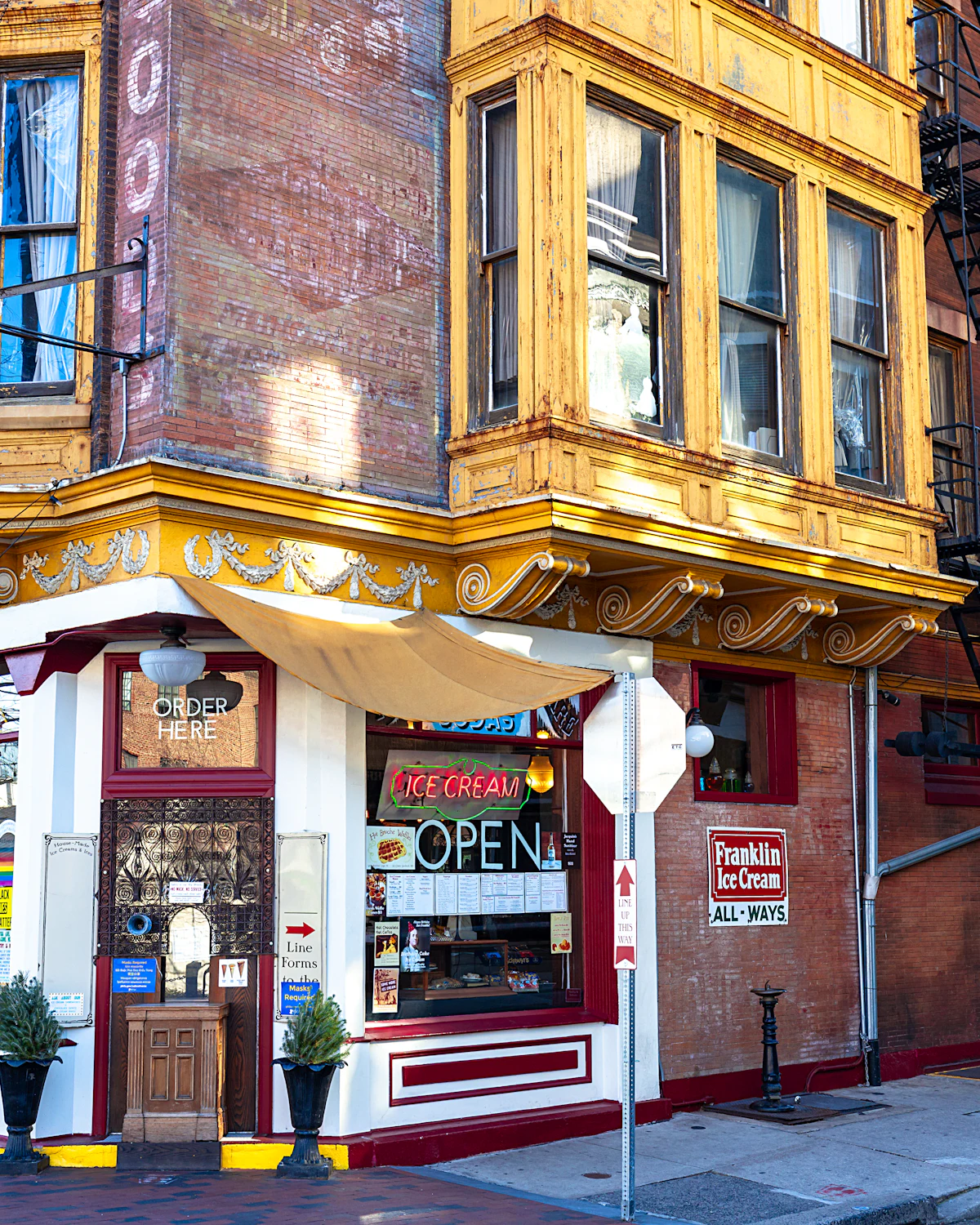
Philadelphia sign permit at a glance
| Question | Short answer |
|---|---|
| Do I need a permit? | Yes: a zoning permit from L&I to erect a sign, to allow its continued placement, or to convert it to a different type, and most signs also need a building permit (when a permit is required). Other cities compared. |
| How big can wall signs be? | Wall, projecting and marquee signs share one allowance per frontage at 1 to 15 square feet per foot of building frontage, depending on your zoning district (Table 14-904-1) (district table). Other cities compared. |
| Window signs? | 20% of the glazed area of each window (§14-904(1)(i)). Other cities compared. |
| What does it cost? | For an accessory sign, $253 each for the zoning permit and $253 each for the building permit (fee table). |
| How long does it take? | The city lists 5 business days for an application using the EZ Standard, against 20 business days for a standard application with plans (how to apply). Other cities compared. |
| Overlay district? | Overlay districts in Chapter 14-500 control over any contrary sign provision. |
| Grand opening banner? | One temporary sign per street frontage needs no zoning permit, up to 12 sq ft per face in a Commercial, Industrial or Special Purpose district. (details) Other cities compared. |
| Digital or LED sign? | Only in the districts listed in Table 14-904-1, with each message lasting at least eight seconds. Other cities compared. |
| Only swapping the sign face? | No zoning permit is needed to change the sign content, as long as the change involves no structural or electrical additions or changes (§14-903(3)). This exempts the zoning permit only. Other cities compared. |
Sizing How to apply FAQ Cost & timeline Permit needed District table Citywide controls No-permit signs Fees Sign companies
How Philadelphia sizes your sign
Table 14-904-1 sets one combined allowance for wall, projecting and marquee signs on each frontage, at a rate per linear foot of building frontage that depends on the district: 1 sq ft in CMX-1, 3 in CMX-2/2.5, 6 in CMX-3, 2 in CMX-4/5, 10 in CA-1/CA-2, 3 in IRMX/ICMX and 15 in I-2/I-3/I-P. On a lot with more than one building frontage, the long side gets a lower rate. CMX-2 and CMX-2.5 also allow one 25 sq ft wall sign instead, CMX-4/5 caps each sign at 100 sq ft, and I-1 and the residential districts give a flat area per lot frontage.
Freestanding signs have their own count, area per face and height in each district, and CMX-1 has no freestanding row at all. Window signs are sized separately, at 20% of the glazed area of each window (§14-904(1)(i)). Overlay districts in Chapter 14-500 control over the table, and the Market Street East district has its own section, §14-906 (§14-902(2)); the calculator above does not model them.
How to apply for a Philadelphia sign permit — 4 steps
Most Philadelphia signs need two permits, and whether you qualify for the EZ Standard decides how much paperwork the second one takes.
Steps assembled from the confirmed items on this page. The permit fees are in “How much does a Philadelphia sign permit cost?” and what drives them is in “Cost, timeline & temporary banners”, both below — not repeated here.
Questions owners ask — 4 questions
Cost, timeline & temporary banners
Detail
Source: City of Philadelphia Department of Licenses & Inspections (zoning and building sign permits); Philadelphia Zoning Code. Fees and timelines change — confirm current figures with L&I before filing.
When Philadelphia requires a sign permit
A Philadelphia sign permit is a zoning permit. §14-903(1)(a) provides that no person shall do any of the following “without first obtaining a zoning permit from L&I pursuant to § 14-303(6),” and the excerpt behind this section covers that permit only — it says nothing either way about a separate building permit.
- Erect a sign. §14-903(1)(a)(.1)
- Allow the continued placement of a sign — leaving an existing sign up is itself one of the listed actions, not only putting one up. §14-903(1)(a)(.2)
- Convert any portion of an existing sign to a different type of sign, “including but not limited to conversion from an accessory to a non-accessory sign or conversion from a non-digital to a digital sign.” Swapping a static face for a digital one is a conversion, not maintenance. §14-903(1)(a)(.3)
The reach is stated in the same subsection: this provision “is applicable to all signs, including any sign required by state or federal law, unless exempted by § 14-903(2).”
§14-903(1)(c) then provides that no zoning permit to erect or use a sign shall be granted unless that sign:
- Complies with the requirements of Chapter 14-900 and the regulations issued pursuant to it. §14-903(1)(c)(.1)
- Complies with all other applicable provisions of the Zoning Code. §14-903(1)(c)(.2)
- Complies with the requirements of the Art Commission, where applicable. §14-903(1)(c)(.3)
- Complies with the regulations of the Department of Parks and Recreation, where applicable. §14-903(1)(c)(.4)
Detail
A sign another law obliges you to post is inside the rule until one of the §14-903(2) exemptions takes it out. §14-903(1)(b) adds that any person owning, operating, or using a structure must comply with the chapter and “shall insure the compliance of all tenants with these requirements by lease or otherwise” — a landlord’s obligation as well as a tenant’s.
Source: Philadelphia Code, Title 14 (Zoning), §14-903(1) When a Permit is Required — repealed and replaced by Bill No. 120430-A, approved January 14, 2013. Read 30 September 2026. The §14-903(2) and §14-903(3) exemption lists are set out in “What needs no zoning permit” below, from the 2 October 2026 reading. Permit fees and processing times are not in this source; they are in the “How much does a Philadelphia sign permit cost?” section below. The document list is not in this source, so this page gives none.
Table 14-904-1: what your district allows, by sign type
The table is split into three here so the columns stay readable. Rows are the table’s own rows; cells are reproduced as the Code states them. “N/A” is the table’s own entry.
Residential districts
| Standard | RSD-1/2/3, RSA-1/2/3, RTA-1, RTA-2, RMX-1/2 | RSA-4/5/6 and RM-1 | RM-2/3/4 and RMX-3 |
|---|---|---|---|
| Sign type | Wall · Freestanding | Wall · Freestanding | Wall, Projecting, and Marquee · Freestanding |
| Maximum number | N/A · N/A | N/A · N/A | N/A · N/A |
| Maximum area (sq. ft. per lot frontage) | Wall — Home Occupations: 1, Non-Residential Uses: 15 · Freestanding — Home Occupations: Prohibited, Non-Residential Uses: 15 | Same as the column to the left | Wall, Projecting, Marquee — Home Occupations: 1, Non-Residential Uses: 24 · Freestanding — Home Occupations: Prohibited, Non-Residential Uses: 15 |
| Maximum height | The lower of the roof line or second floor window sill · 7 ft. | Same as the column to the left | The lower of the roof line or second floor window sill · 7 ft. |
| Additional requirements | N/A · Prohibited in required setbacks | Same as the column to the left | N/A · Prohibited in required setbacks |
| Illumination and motion | Static: Yes · Animated: No · Mechanical motion: No | Same as the column to the left | Static: Yes · Animated: No · Mechanical motion: No |
Source: The Philadelphia Code §14-904 Table 14-904-1 (2026 Code), read 2026-10-02.
Commercial districts
| Standard | CMX-1 | CMX-2 and CMX-2.5 | CMX-3 | CMX-4 and CMX-5 | CA-1 | CA-2 |
|---|---|---|---|---|---|---|
| Sign type | Wall and Projecting | Wall, Projecting, and Marquee · Freestanding | Wall, Projecting, and Marquee · Freestanding | Wall, Projecting, and Marquee · Freestanding | Wall, Projecting, and Marquee · Freestanding · Portable | Wall, Projecting, and Marquee · Freestanding · Portable |
| Maximum number | Wall: N/A, Projecting: 1 per frontage | Wall: N/A, Projecting: 1 per frontage · Freestanding: 1 per building | N/A · Freestanding: 1 per building | N/A · Freestanding: 1 per frontage | N/A · Freestanding: 1 per lot · Portable: 1 per building frontage | N/A · Freestanding: 1 per 15,000 sq. ft. of lot area · Portable: 1 per building frontage |
| Maximum area | Lots with one building frontage: 1 sq. ft. per lin. ft. of building frontage. Lots with more than one building frontage: Short side(s): 1, Long side: 0.5 | Lots with one building frontage: 3 sq. ft. per lin. ft. of building frontage, or Wall: one 25 sq. ft. sign. Lots with more than one building frontage: Short side(s): 3, Long side: 2, or Wall: one 25 sq. ft. sign per building frontage · Freestanding: 100 sq. ft. total | Lots with one building frontage: 6 sq. ft. per lin. ft. of building frontage. Lots with more than one building frontage: Short side(s): 6, Long side: 4 · Freestanding: 100 sq. ft. per face; up to 2 faces | 2 sq. ft. per lin. ft. of ground floor frontage; 100 sq. ft. per sign · Freestanding: 50 sq. ft./face; up to 4 faces | 10 sq. ft. per lin. ft. of ground floor frontage of the business or tenant with which the sign is associated · Freestanding: 200 sq. ft./face, up to 2 faces · Portable: 10 sq. ft. | 10 sq. ft. per lin. ft. of ground floor frontage of the business or tenant with which the sign is associated · Freestanding: 150 sq. ft./face, up to 4 faces · Portable: 10 sq. ft. |
| Maximum height | The lower of the roof line or second floor window sill | The lower of roof line or second floor window sill · Freestanding: 20 ft. | The lower of roof line or second floor window sill · Freestanding: 20 ft. | The lower of the roof line or second floor window sill · Freestanding: 10 ft. | The higher of the roof line or parapet wall, if applicable · Freestanding: 40 ft. · Portable: 5 ft. | The higher of the roof line or parapet wall, if applicable · Freestanding: 40 ft. · Portable: 5 ft. |
| Additional requirements | — | — | — | Notwithstanding §14-904(1)(d), projecting signs shall not extend more than 24 in. over any public right-of-way · Freestanding: N/A | — | — |
| Illumination and motion | Static: Yes · Animated: No · Digital display: No · Mechanical motion: No | Static: Yes, except that in the CMX-2.5 district internally-illuminated cabinet signs shall be prohibited · Animated: No · Mechanical motion: Yes | Static: Yes · Animated: No · Mechanical motion: Yes | Static: Yes · Digital sign: Wall: Yes, Others: No; Freestanding: Yes · Electronic message sign: Wall: Yes, Others: No; Freestanding: Yes · Mechanical motion: Yes | Static: Yes (Portable: No) · Digital sign: Wall: Yes, Others: No; Freestanding: Yes; Portable: No · Electronic message sign: Wall: Yes, Others: No; Freestanding: Yes; Portable: No · Mechanical motion: Yes (Portable: No) | Static: Yes (Portable: No) · Digital sign: Wall: Yes, Others: No; Freestanding: Yes; Portable: No · Electronic message sign: Wall: Yes, Others: No; Freestanding: Yes; Portable: No · Mechanical motion: Yes (Portable: No) |
Source: The Philadelphia Code §14-904 Table 14-904-1 (2026 Code), read 2026-10-02.
Industrial and industrial-mixed districts
| Standard | IRMX and ICMX | I-1 | I-2, I-3, and I-P |
|---|---|---|---|
| Sign type | Wall, Projecting, and Marquee · Freestanding | Wall, Projecting, and Marquee · Freestanding | Wall, Projecting, and Marquee · Freestanding |
| Maximum number | N/A · Freestanding: 1 per lot frontage | N/A · Freestanding: 1 per lot frontage | Others: N/A · Freestanding: 1 per lot frontage |
| Maximum area | Lots facing one street line: 3 sq. ft./lin. ft. of building frontage. Lots facing more than one street line: 3 sq. ft./lin. ft. on the short side, 2 sq. ft./lin. ft. on the long side · Freestanding: 100 sq. ft./face, up to 4 faces | 100 sq. ft. per lot frontage · Freestanding: 100 sq. ft./face, up to 4 faces | 1 street front: 15 sq. ft./lin. ft. of building frontage. 2 or more street fronts: 15 sq. ft./lin. ft. on the short side, 5 sq. ft./lin. ft. on the long side · Freestanding: 100 sq. ft./face, up to 4 faces |
| Maximum height | The lower of the roof line or second floor window sill · Freestanding: 20 ft. | The lower of the roof line or second floor window sill · Freestanding: 20 ft. | The lower of the roof line or second floor window sill · Freestanding: 20 ft. |
| Illumination and motion | Static: Yes · Digital sign: Wall: Yes, Others: No; Freestanding: Yes · Electronic message sign: Wall: Yes, Others: No; Freestanding: Yes · Mechanical motion: Yes | Static: Yes · Digital sign: Wall: Yes, Others: No; Freestanding: Yes · Electronic message sign: Wall: Yes, Others: No; Freestanding: Yes · Mechanical motion: Yes | Static: Yes · Digital sign: Yes · Electronic message sign: Yes · Mechanical motion: Yes |
Special Purpose Districts: sign controls for the Special Purpose Districts are shown in the regulations for those districts in Chapter 14-400 (Base Zoning Districts).
Source: The Philadelphia Code §14-904 Table 14-904-1 (2026 Code), read 2026-10-02.
The controls that apply in every district
Animated illumination — §14-904(1)(b)
Signs with animated illumination are permitted in base zoning districts as set forth in Table 14-904-1, and then four limits apply wherever they are allowed. They are prohibited within 200 ft. of the point where two or more streets intersect. They are prohibited within 150 ft. of a Residential district, and prohibited from facing a Residential district within 300 ft. Except for an Accessory Digital News Ticker, each message must last no less than 8 seconds and the transition between messages no more than 0.25 seconds. Luminance may be no greater than 1,500 nits during daylight hours and no greater than 150 nits at all other times, and automatic dimming is required.
Directional signs — §14-904(1)(c)
A directional sign may not exceed 10 sq. ft. in total area or 7 ft. in height, except for a clearance sign. Logos may not exceed 10% of the total area of the sign. Projecting directional signs are permitted. Animated illumination and mechanical motion are prohibited.
Projection over a public right-of-way — §14-904(1)(d)
The allowed projection is set by how high the lowest point of the projection sits above the right-of-way. Below 8 ft., the sign may not project more than 6 in. At 8 ft. or more and no more than 10 ft., not more than 2 ft. Above 10 ft., not more than 4 ft. or two-thirds of the width of the sidewalk, whichever is less.
Menu boards — §14-904(1)(d.1)
A take-out restaurant with a drive-through is permitted a maximum of 2 freestanding menu boards, each no greater than 55 sq. ft.
Projecting signs, roof signs and wall signs — §14-904(1)(e), (f), (h)
A projecting sign may not project more than 4 ft. from the building facade it is attached to. Roof signs are prohibited in all districts. A wall sign may not extend above the lower of the roof line or the second floor window sill.
Window signs — §14-904(1)(i)
Window signs are limited to the ground floor, except that in the CMX-2, CMX-2.5, CMX-3, CMX-4, CMX-5, CA-1 and CA-2 districts, window signs for businesses that are not located on the ground floor are also permitted in second floor windows. The total area of signs placed within a window or transparent glass door may not exceed 20% of the total transparent glazed area of that window or transparent glass door. That area is in addition to the maximum sign area permitted in §14-902(2), so it does not come out of the per-linear-foot allowance above. Signs may be placed in no more than two windows; two transparent glass doors; or one window and one transparent glass door.
Source: The Philadelphia Code §14-903(2), §14-903(3), §14-904(1) (2026 Code), read 2026-10-02.
What needs no zoning permit
No permit, but the sign must still conform — §14-903(2)
- Placement of window signs, subject to the requirements of §14-904(1)(i).
- A directional sign required by state or federal law, subject to the requirements of §14-904(1)(c).
- One temporary sign per street frontage, not exceeding six sq. ft. per sign face in a Residential district and 12 sq. ft. per sign face in a Commercial, Industrial, or Special Purpose district.
- A sign within a premises that is not located and designed to be viewed by the public outside the premises — an interior sign more than 18 in. away from any window, door or other aperture through which it could be viewed, or at an angle of more than 45 degrees from the plane of that aperture.
- A video or digital display with a screen area of less than one sq. ft., designed to be viewed only by a person obtaining services or goods at that location.
No permit and no conformance required — §14-903(3)
- Changing sign content, including a change from a commercial to a non-commercial message, provided the content change involves no structural or electrical additions or changes.
- The customary maintenance of any sign.
Source: The Philadelphia Code §14-903(2), §14-903(3), §14-904(1) (2026 Code), read 2026-10-02.
Sources & how this page is maintained
Sources and official references: Philadelphia Code — Title 14 Zoning, §14-904 Accessory Sign Controls, district table and §14-903 When a Permit is Required. Table 14-904-1, §14-902(2), §14-903 and §14-904(1) were read on 30 September and 2 October 2026 and are stored verbatim in monitors/srccache. On 10 October 2026 the code library returned a bot check instead of the text, so the calculator was built from the 2 October reading. Fees and review times come from the city’s L&I fee summaries, read 7 October 2026.
How much does a Philadelphia sign permit cost?
Philadelphia prices signs per sign, not by size. The number you need depends on which permit you are pulling, because the zoning side and the building side publish different amounts for the same kind of sign.
Philadelphia is also one of the few cities that publishes how long it takes.
| Permit | Accessory sign | Non-accessory sign |
|---|---|---|
| Zoning permit | $253 each | $398 each |
| Building permit | $253 each | $316 each (outdoor advertising) |
The Philadelphia Code still prints $200 and $315 for these, which the city's current fee summaries supersede.
| Other charges | Amount |
|---|---|
| Application filing fee, applications with plans | $100, credited against the final permit fee |
| Accelerated review, optional | $1,050 total, $350 up front |
| City surcharge | $3 per permit |
| State surcharge | $4.50 per permit |
| Lawful occupancy sign, initial issue | $189 per sign |
| Lawful occupancy sign, replacement | $29 per sign |
Outdoor advertising carries a separate licence, charged at $0.63 per square foot of sign face for the first five years and $1.26 per square foot for each five years after that.
| How long it takes | Time |
|---|---|
| Standard application with plans | 20 business days |
| Accelerated review | 5 business days |
| Application using the EZ Standard | 5 business days |
| In-person application without plans | Processed while you wait |
Source: City of Philadelphia Licenses and Inspections, Summary of zoning permit fees (PZ_008_INF, Rev 7.2026) and Summary of construction permit fees (PG_012_INF, Rev 7.2026, effective October 1, 2026), with the surcharges, filing fee and review times from the city's sign permit service pages. Read 7 October 2026.
Philadelphia sign companies that say they handle the permit
Compiled from each company's own public website. We are not affiliated with any of them and we are not paid to list them. Confirm licensing and pricing yourself before you hire.
| Company | Phone | Location | What their site says about permits | In-house |
|---|---|---|---|---|
| Bernard Sign Corporation | 215-425-1700 | 3325 Rorer Street, Philadelphia, PA 19134 | we handle every step of the process, including sign design, permitting, engineering coordination, fabrication, installation, and ongoing maintenance | Our experienced sign installation team helps businesses create a strong visual presence with durable, professionally installed signage. |
| Martino Signs | (610) 662-5557 | 620 Grant Road, Folcroft, PA 19032 | We manage the permit process at every location in the program | We fabricate all signs in-house at our 25,000 sq ft Philadelphia facility. |
| FASTSIGNS of Philadelphia, PA - Center City | (215) 960-9497 | 200 N 16th Street, Philadelphia, PA 19102 | Our specialists will perform accurate surveys and procure the appropriate permits to ensure your signage is in full compliance. | - |
Each company's website is linked from its name. Source pages read 7 October 2026.
Ask us how the code reads for your sign
Send your dimensions and we will reply with what the Philadelphia code allows for that sign. No charge. We are not a sign contractor and not a permit agent.